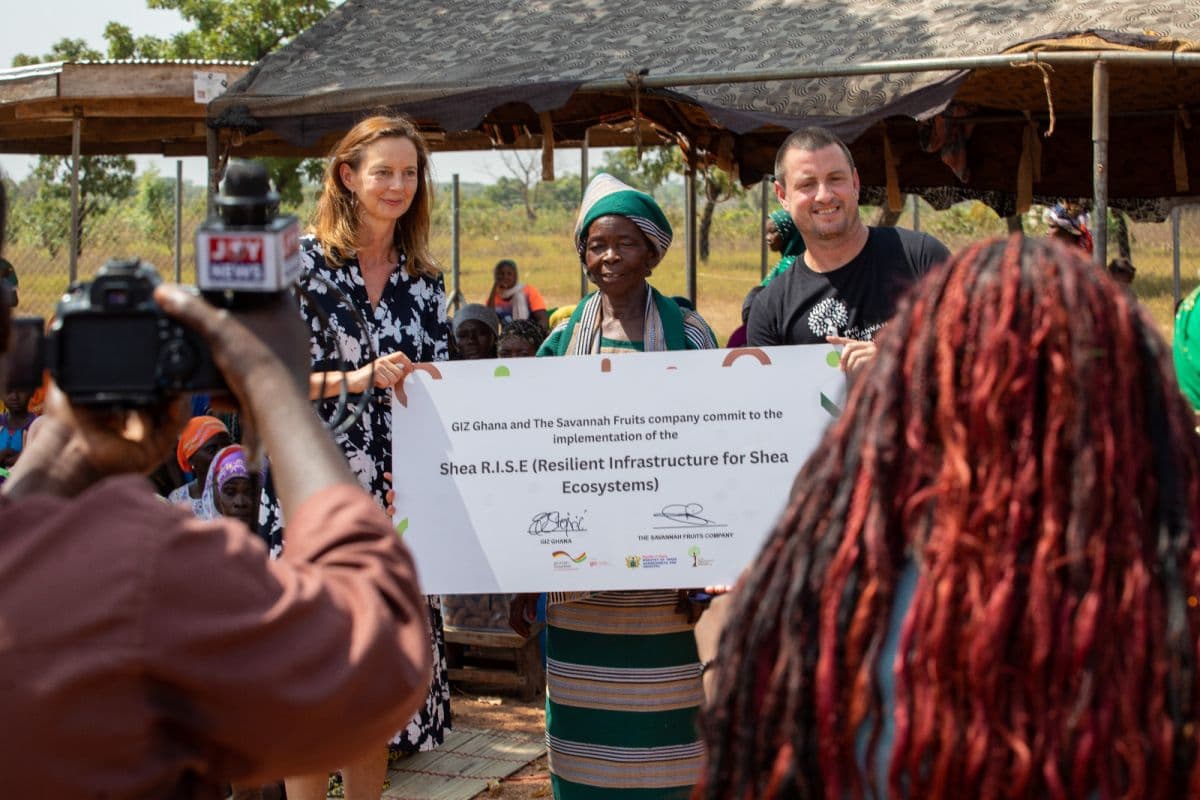
The Savannah Fruits Company and GIZ Ghana have signed a €1.3 million agreement to strengthen women‑led shea businesses and generate employment in northern Ghana. The deal is part of the Shea RISE (Resilient Infrastructure for Shea Ecosystems) project, which aims to turn 16 cooperative‑owned post‑harvest centres into autonomous, well‑managed enterprises run by women.
The initiative brings together GIZ’s Private Sector and Innovation Promotion programme, the Ministry of Trade, Agribusiness and Industry, The Savannah Fruits Company and local communities. Arlett Stojanovic, Head of Programme for PSInno at GIZ Ghana, said the German government had allocated funding to create jobs and increase incomes, particularly in the north of Ghana. She added that the project would help women generate income throughout the year rather than rely on the seasonal shea collection period.
Shea supports about 16 million women across West Africa, and the project plans to bring 4,000 women collectors and processors into registered cooperatives by 2028. It will also train 4,032 people, including 32 RISE Fellows, with 16 trainees expected to become Centre Managers. Women are expected to occupy at least 60 per cent of those positions.
Raphael Gonzalez, Managing Director and Co‑founder of The Savannah Fruits Company Ltd, said the project would enable women to collect more shea nuts, receive immediate cash payments and work together in safer conditions. He highlighted that the timing coincides with the start of the rainy season, allowing women to use the money for other needs.
Beneficiaries such as Mariama Zakaria Magajia of the Nyeko Women’s Group have already noted how the introduction of machinery has eased traditional processing methods. Meanwhile, Eco‑Restore founder Senyon Pele warned that cutting down shea and other indigenous trees threatens raw material availability for factories, underscoring the need for sustainable practices.
The wider ambition of Shea RISE is to expand the model to 90 centres across northern Ghana, reaching an estimated 22,500 women shea collectors and processors. Running from October 2026 to October 2028, the project will transition 16 high‑performing centres from the pilot phase into autonomous, formally governed and bankable women‑led cooperative enterprises. Biomass boilers and deshelling machines will be installed across all 16 centres, and all purchased shea volumes will be traceable at batch level.
As the partnership moves forward, stakeholders will monitor progress toward formalising about 4,000 women collectors and processors as cooperative members and training 32 young RISE Fellows to manage the centres, aiming to establish a practical and replicable model for the first mile of the shea value chain.